For founder-led ecommerce brands
The store is running.
Something still
feels off.
You have the data. Meta, Shopify, GA4, Klaviyo — each telling you something different. The problem is rarely missing information. It's that no one has looked across all of it and told you plainly what it means.


The more data you have, the less obvious the next step feels.
Orders come in. Campaigns run. Reports arrive. You've grown — and with that growth came more tools, more dashboards, more numbers. Each platform is telling the truth. None of them is telling the whole story.
The problem isn't that you need better tools or a unified dashboard. It's that someone needs to look across all of it and say plainly what it means for this business, right now.
Each platform sees through its own lens, for its own purpose. Each one is telling the truth. None of them is telling the whole story. And pulling them into a single dashboard doesn't change what the numbers underneath actually describe.
Everyone working for you has a reason to say things are working.
Your ads person needs strong ROAS to keep the contract. Your email agency needs open rates to justify their retainer. Your analytics consultant needs complexity to stay relevant. They're not lying — they're showing you the slice they control, and making it look as good as they can.
I don't have that motivation. No retainer to protect, no channel to defend. I come in, look at everything, tell you what I see, and leave. That's it.
Most founders already sense the answer. They just haven't had someone willing to look across all of it — without a stake in the outcome — and say plainly what it suggests.
Small brands. Two people. Real decisions.
You run this with someone.
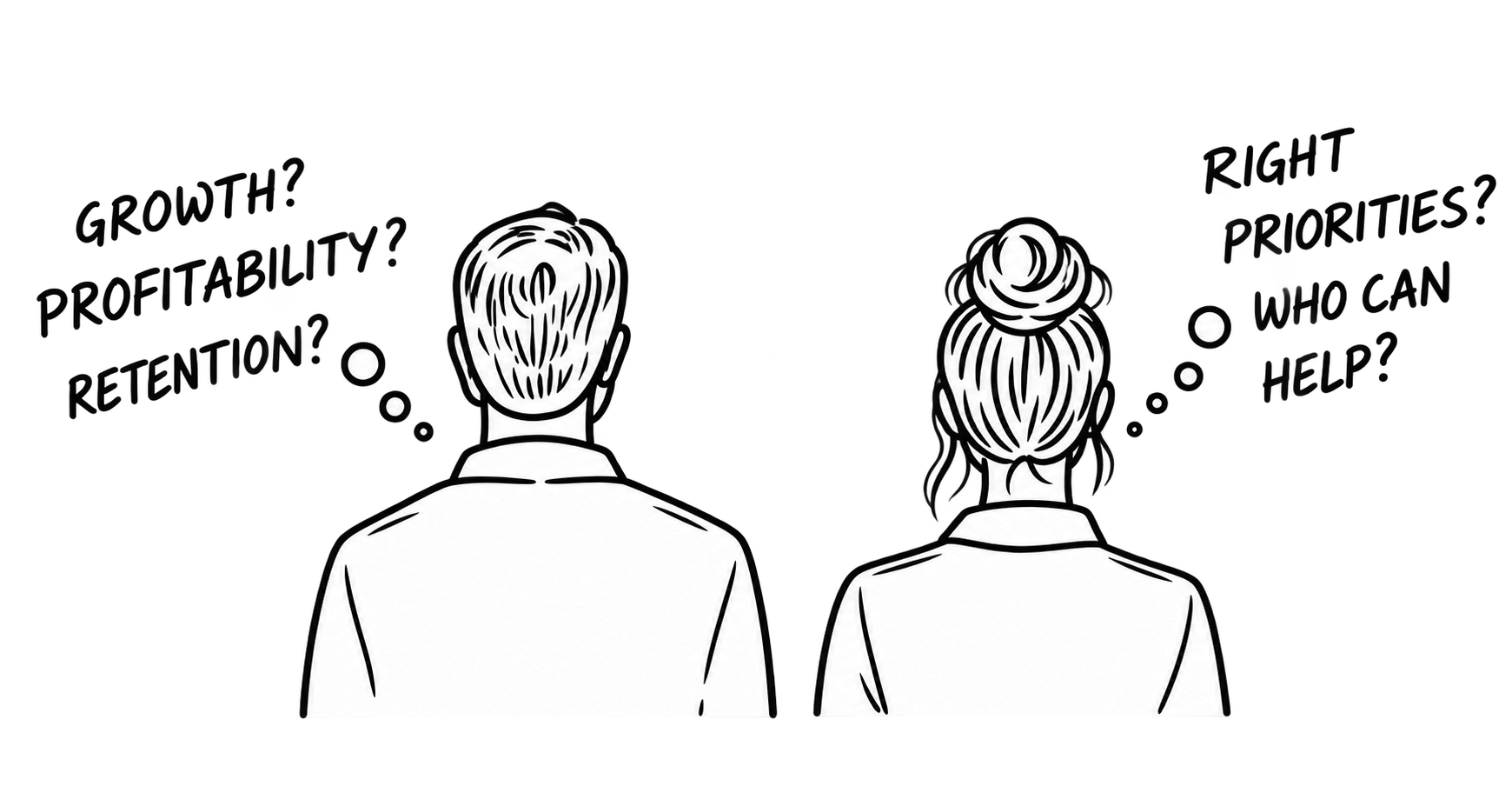
A partner, a spouse, a sibling. You built this together, you carry the anxiety together, and you make the calls together. You don't need a pitch deck — you need a clear explanation you can both look at and say: yes, that's what's happening. This is designed for how you actually work.
The business is working. The picture isn't clear.
You're doing €500k to €3M. Orders come in. You've added channels, tools, agencies. But somewhere in the growth, you lost the ability to see the business clearly. You know something deserves attention — you just can't find it in the reports.
You're not looking for more tools.
Every solution you've been sold added a new layer. A new dashboard. A new integration. Another thing to check. You want someone to look at what's already there — and actually tell you what it means.
Your brand isn't generic. The approach shouldn't be either.
You built something specific — a product category, an audience, a way of working. You're not interested in playbooks designed for brands ten times your size. You need someone who looks at this business, not a template of it.
I come in, look, tell you what I see, and leave.
Not a retainer. Not another tool to manage. A clear-eyed look at your business from someone who's spent 13 years sitting between marketing and data — and has no stake in the outcome.
We look at the business together.
Across your ads, your orders, your margins, your email — the whole picture. I don't start with a template. I start with what you're actually uncertain about.
I tell you plainly what I see.
What looks healthy. What looks weak. What deserves attention first. Not ten charts. One clear read — plain enough to act on, specific enough to be useful.
You leave knowing what to do next.
If you want, I stay on for a bit — to show how to build a data-driven approach into the way you run things. But the goal is always to hand clarity back to you, not to create dependency on me.
I don't add a tech layer if it isn't needed. Most brands already have more data than they can read. My job isn't to give you another dashboard to check — it's to help you understand what the data you already have is actually saying.
Three things that looked like data problems.
Weren't.
Each one sounded technical at first. Each one turned out to be something simpler — and harder to see from the inside.
A brand believed their newsletter was driving repeat orders.
Email opens correlated with repeat purchases. The numbers supported it.
Some customers reordered the same day — they had forgotten something. Others returned naturally after the first order arrived. The email appeared influential. The decision had happened elsewhere.
- —Time between order and reorder
- —Whether the email arrived before or after the decision was made
- —Natural reorder rate without any email as a baseline
A founder believed free products were working well.
Free product orders — many. Second purchases — very few. Most people stopped after the first claim.
People were interested but unsure where to begin. The free product attracted them. Nothing guided them forward.
- —Second purchase rate by entry type
- —Time from free claim to first paid order
- —LTV of free-entry vs paid-entry customers
A founder changed who the business was trying to attract.
The strategy and messaging had changed. But had the right customers actually changed too? There was no demographic data. No profile to compare.
No demographic data was available. So the answer came from what customers chose to buy instead. Behavior shows up before the data does.
- —Which product categories are growing
- —How average order value shifts over time
- —Which items new customers buy first
Seeing the business from the outside.
I've spent 13 years sitting between marketing and data — close enough to understand both, detached enough to say when one is misleading the other. I now work exclusively with small, niche ecommerce brands. The kind built by one or two people with a specific vision.
Founders are close to their business for good reason. But that closeness can make the label hard to read. I look underneath the dashboards — across the ads, the orders, the returns, the margins — and put together a picture that's plain enough to act on.
I have a background in business and marketing. I don't come to sell you tools, complexity, or a new methodology. I come to help you see your business again.
13 years between data and marketing, across ecommerce
Degree in business analytics and marketing
No retainer motivation. No channel to defend. No tool to sell.
Based in Barcelona. Working with niche brands that think big.
"I help you look at the business from a fresh perspective so marketing feels clear and enjoyable again."
No new dashboard. No new tool. No new layer.
Every solution you've been sold added complexity. I don't. I work with what's already there — your Shopify data, your Meta account, your GA4, your Klaviyo — and I make sense of it. If a new tool would genuinely help, I'll tell you. Most of the time, it won't.